
Shopping Cart

- On sale!
- -30%

IF YOU WANT TO BUY RESIN FOR FIXING AGGREGATES AND CRUSHED STONE, CLICK HERE
Both the entrance to a house and the path of a small garden need a walkway. But what if, instead of laying tiles, you opted for natural stone, marble, gravel, or other crushed aggregates?
They will give a more rustic look, and on the other hand, installation is much simpler.
Some of its qualities:
Stone is more economical and easier to maintain than grass.
It is attractive, trouble-free, and easy to install.
Its use in planting areas helps protect the soil from sudden temperature changes and maintain greater soil moisture.
In terms of design, it harmonizes very well with plants and other materials such as wood, concrete, or metal.
It adapts to irregular contours and is effective in both large and small areas.
Due to its variety and ease of color combination, the most diverse shapes and designs can be created, with decorative motifs, etc.
And they also offer a lot of possibilities not only because of the varieties, but also because their appearance changes depending on the light and whether the material is wet or dry

To maintain the look and shape of your chosen design forever, you have the option of using paving resins or aggregate binder that will compact the surface.
It is a one-component, matte-finish product that virtually does not alter the appearance of the stone
It is a resin specially manufactured and designed to be mixed with different types of aggregates used in landscaping, for the construction of garden paving, playgrounds, roundabouts, etc.
Hygienic solution that facilitates cleaning and greater use of public spaces (sidewalks, parks, etc.) In addition to the elimination of architectural barriers
The aggregate is bound and compacted, preventing it from becoming soiled as it is not washed away by weather elements such as rain or wind.
It is a flexible product, so it does not add rigidity to the pavement, unlike other products on the market. This is especially important in tree pits, where thermal shock often causes the existing pavement to lift and crack.
The product has high resistance to weathering and does not yellow. This is particularly important if the pavement is made of white stone or light colors, where yellowing is easily noticeable.
It also does not release any harmful substances, either during handling, application, or once cured, that could affect the normal growth and health of vegetation.
Its unique mixing method (using a concrete mixer) prevents the formation of a continuous resin film; instead, the resin envelops the aggregate to create drainage. This allows vegetation, in the case of tree pits, to continue receiving the necessary rainwater or irrigation water and oxygen diffusion to the roots.
It also protects vegetation, especially tree roots, as it preserves soil moisture in summer and retains soil heat in winter. It also limits weed growth, depending on the aggregate size.
In fragile soils, it helps combat erosion.
It saves time and labor in the maintenance (pruning, watering, and debris removal) of garden paving and tree pits.
Specifically, in the case of trees, if the application (pouring the material onto the substrate) results in a very uneven finish, hindering the normal movement of animals (such as dogs or cats) as they feel uncomfortable walking on the surface, it can prevent them from approaching and avoid unpleasant odors.
Our product is ready to use; it does not need to be diluted, as reducing the resin solids will decrease its adhesive capacity
It is recommended, especially with larger particle sizes, to spread a weed barrier over the substrate before pouring the aggregate along with the product, to prevent weed growth.
To prepare the mix, pour the required amount into the concrete mixer along with the aggregate or suitable material for this application. Mix for 10 minutes until a completely homogeneous mixture is obtained.
The mixture can then be poured directly onto the mold or substrate and compacted
Drying time depends on the thickness of the pavement; for 4 cm thick, 3 days of drying are recommended.
Tool cleaning: rinse with water
Consumption depends on the type of aggregate selected. Examples:
For marble dust with a particle size of 7-12 mm, 7% of the aggregate weight is needed.
For gravel with a particle size of 15-25 mm, 3% of the aggregate weight is needed.
Installing aggregates, gravel, or crushed stone in a garden is very simple, so simple that you can do it yourself without any problem.
Installing aggregates, gravel, or crushed stone in a garden is very simple, so simple that you can do it yourself without any problem.
The first step is to prepare the ground. The gravel or crushed stone you are going to place in your garden will occupy space and depth, and if that space doesn't exist, you must create it
If you want to replace a lawn area with decorative garden gravel, you first have to remove the existing lawn so the gravel can be used.
It's likely that your garden has elements that define the maximum possible levels, such as paving, which marks a level you won't be able to exceed with the gravel. This will force you to "make room" by removing grass or lowering the ground level by taking away soil.
However, it's also possible to create this space by installing garden edging made of stones, concrete blocks, wood, aluminum, etc.

The thickness or layer of gravel you should place will depend on the size or granulometry, that is, the millimeters the aggregate or gravel measures
For very small gravel or pebbles, even a 3 cm layer may be sufficient; however, for larger gravel, a greater layer thickness is necessary to ensure adequate coverage.
As a general rule, we recommend a layer between 5 cm and 10 cm.
For medium-sized gravel (2 to 4 cm), we always calculate a 7 cm layer. If you have a greater depth to fill, you can use compacted sand, which will be more economical than other types of gravel.
Gravel or pebbles is sold by the cubic meter (m³) or by the kilogram (kilogram). You can also find it in liter bags, but 1000 liters is 1 m³, so you can calculate the conversion, or even ask the gravel supplier for advice
If you want to calculate the amount of gravel or aggregate you will need in m³, you must multiply the m² of the area you want to cover by the desired layer thickness in cm.
For example, if you have an area of 10 meters x 10 meters, that is 100 m² (10 x 10 = 100).
If you want to lay a 5 cm deep layer, then you need 5 m³ (100 x 0.05 = 5), or 5,000 liters, which is the same
Tip! If you want to buy gravel by the kilo, calculating the necessary amount becomes a bit more complicated. It will depend on the weight of the gravel, as not all types weigh the same; for example, volcanic gravel is much lighter than marble gravel.
A guide table that can help you calculate the amount of gravel needed by the kilo or ton.
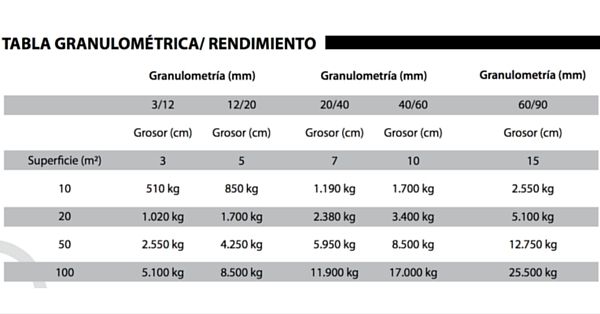
It is advisable to first treat the soil with a herbicide.
Afterward, you should try to minimize future weed growth by placing a mesh on top of the soil and under the gravel to prevent weeds from growing
This weed barrier fabric is perforated to allow water to pass through, so occasionally a weed will slip through and appear, but it GREATLY reduces weed growth, which is why I definitely recommend using it to ensure the gravel area requires virtually no maintenance. (A 130 g/m² fabric is recommended) or a geotextile fabric.
It is not advisable to use non-specialized plastics, because the water will not drain, causing waterlogging.
Once you have placed the plants you want to use to decorate your garden, all that remains is to lay the decorative or compacted gravel, depending on the finish you want to achieve, as we have explained with the aggregate fixative, stone adhesive, or binder for crushed stone.
.
DONE! NOW YOU CAN ENJOY A PERMANENT AND DECORATIVE GARDEN THAT WON'T REQUIRE ANY MORE WORK
Comments (3)