

Shopping Cart
How to paint a swimming pool step by step?
It goes without saying that buying high-quality paint for the pool will also be our priority, a very important factor along with proper application.
We advise against buying excessively cheap paint, as it loses its color and waterproofing shortly after application. (These paints contain very little resin.)
There are common processes for painting a swimming pool, regardless of the type of pool and the product chosen to paint it.
When repairing and painting a swimming pool, it is essential to be very clear about what type of product was previously used, if it was already painted, as there are different types of paints and not all of them are compatible with each other.
Types of paints for swimming pools
- Open Pore Paint : It is specially designed for unsealed concrete pools or pools with fresh stucco, as it acts as a curing membrane.
- Acrylic or Chlorinated Rubber Paint : This paint is used on concrete, cement, masonry, and tiled swimming pools, as well as other structures in high-humidity environments. It is completely waterproof, preventing water loss and small cracks, and inhibiting the growth of mold and algae.
How to choose the right type of paint for your swimming pool
We explain the difference between an acrylic paint for swimming pools and a chlorinated rubber paint for swimming pools.
Everyone knows about chlorinated rubber paints, which have been used for many years and give very good results.
Acrylic pool paints are more modern than chlorinated rubber paints; they are an improved formula of chlorinated rubber paints, but their manufacture and use are identical.
If we already have a chlorinated rubber paint applied to our pool, we can apply on top of it either another chlorinated rubber paint or a solvent-based acrylic pool paint.
Steps to follow to paint a swimming pool
1. Thoroughly clean the surface of the pool before painting
- If the pool is full, it must be drained and allowed to dry before making any repairs.
- Use a spatula to remove loose paint. We will need to remove loose particles or layers of paint with a spatula.
- Mark the cracks (if any) by tapping them with the tip of the spatula. The aim is to leave the crack completely exposed and unpainted.
- Use an orbital sander or sandpaper to gently polish the walls and floor of the pool.
- The idea is simply to remove the loose paint and leave the walls perfectly prepared for repairing cracks and repainting the pool.
- Using the same pool paint that will be used later, it is necessary to seal the cracks and bare patches that remained after using the spatula and sander.
- If the cracks were larger than 2mm, we could apply pool paint with a little fiberglass , or use a bonding agent to repair the cracks with cement.
- Using a brush, sweep the bottom and walls of the pool to remove dust.
- Wash with a hose and a stiff brush to remove any remaining suntan lotion and algae from last season (especially at the waterline).
If the dirt in the pool is heavily ingrained and difficult to clean, you can use stronger descaling products available on the market, or use bleach, ammonia, or hydrochloric acid. (If you use hydrochloric acid or strong chemicals, you must clean thoroughly afterward with soap to remove the silicone residue these products leave on the surface, which prevents the paint from adhering properly.)
Afterwards, to rinse the pool walls, a good option is to use a pressure hose, or a pressure washer.
2. Paint following the application instructions for each type of pool
ALWAYS DILUTE POOL PAINT OR VARNISH PROPERLY .
In the product data sheets, we indicate the percentage of solvent and the type of solvent that should be used with each type of paint.
If in doubt, consult the manufacturer to advise you on the correct paint dilution percentage.
Applying very thick layers of paint or undiluted pool paint can cause:
-That the paint chips or does not adhere properly to the surface. (Over time, pieces may fall off)
-That when applying the paint with the roller, it produces bubbles that will then turn into blisters when they dry.
-Because the layers are so thick, they dry on the surface, but the solvents at the bottom of the layer don't evaporate, preventing proper drying. (The bottom of the layer remains undried.)
APPLY THE PAINT IF POSSIBLE FIRST THING IN THE MORNING.
We recommend NOT PAINTING the pool during the MIDDAY HOURS, and if possible, not in the afternoon either (in case it is very hot).
If the surface you're painting is very hot, or if the temperature when applying the paint is very high, the heat can cause the paint to dry very quickly because the surface is so hot and the solvent evaporates too rapidly. (It's best to apply it first thing in the morning.)
Allow the pool paint or varnish to dry between coats for a minimum of 6 hours and a maximum of 24 hours.
Always allow the pool paint or varnish to dry properly between coats to prevent blisters or bubbles from appearing.
The drying time will depend on the ambient temperature and relative humidity, but we recommend leaving it to dry until the following morning, to apply the next coat again first thing in the morning.
TIPS FOR PAINTING CEMENT, CONCRETE, OR MASONRY SWIMMING POOLS

Although painting a masonry, concrete, or cement pool is not at all complicated, we must take certain factors into account to ensure the paint is durable and maintains all its properties throughout the year.
Mainly, the advice we should follow is the same as that common to all swimming pools, which we explained a little earlier.
We advise waiting between 24 and 72 hours after draining the pool for it to dry completely before painting.
And wait between 5 days and 1 week after painting before refilling the pool with water for perfect results.
-Stir the material very well; the surfaces to be painted must be dry, clean, and consistent.
-If the soil is not very porous, a chemical or mechanical treatment will have to be carried out to open the pores and achieve better adhesion.
PAINTING NEW SWIMMING POOLS
If you wish to apply a first coat to use as a primer, dilute the paint with approximately 20% solvent.
Apply one or two coats to homogenize texture and desired coverage (with a 5% dilution). Masonry surfaces must be thoroughly dry to allow moisture and alkalinity levels to decrease as much as possible.
On new concrete or cement, you will have to wait for it to fully set (approximately 30 days).
PAINTING ALREADY PAINTED POOLS
If the surface to be painted is in good condition, remove the dust, and apply one or two coats of special pool paint.
If the old surface is in poor condition, loose and poorly adhered surfaces should be removed and the surface treated as if it were new.
TIPS FOR PAINTING OR VARNISHING A TILED OR GRILLED POOL
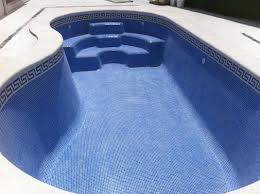
The process for painting or varnishing a tiled or mosaic pool is the same as for a concrete pool; the only difference is that we will have to dilute the paint or varnish with different percentages of solvent for perfect adhesion, since these surfaces are less porous and make it difficult for the paint or varnish to adhere properly.
APPLICATION TIPS FOR LOW POROSITY SUBSTRATES
We advise waiting between 24 and 72 hours after draining the pool for it to dry completely before painting.
And wait between 5 days and two weeks after painting or varnishing before refilling the pool with water for proper application. (The longer it dries, the better.)
-Stir the material very well; the surfaces to be painted must be dry, clean, and consistent.
-The surfaces to be painted must be free of dust, lime, grease and old paint and be completely dry.
-Clean the mosaic tiles well to remove any limescale residue, so that when the waterproof varnish is applied on top, it does not whiten and the limescale residue is noticeable.
-If the surface is not very porous, it is recommended to roughen it with a chemical or mechanical abrasive for perfect paint adhesion. (Especially in the case of ceramic tiles)
-Homogenize the contents of the container by stirring thoroughly.
-The application can be done with a brush or roller
-In the case of ceramic tiles, a first coat should be applied with a 30-35% dilution with solvent for proper adhesion. On other surfaces, a 15% dilution can be applied.
-The second coat should be applied by spreading the varnish well to avoid thick layers, diluted between 10% and 15% with solvent.
-To achieve good adhesion between layers, do not let more than 24 hours pass, but allow the layers to dry well to avoid the appearance of bubbles or blisters.
-Allow to dry properly before painting and before filling with water (minimum 48 hours)
IF YOU WANT IDEAS FOR CHOOSING THE COLOR OF YOUR POOL, CLICK HERE
IF YOU WANT TO KNOW HOW TO MAKE A MURAL IN THE POOL, CLICK HERE
PRECAUTIONS WHEN APPLYING ACRYLIC VARNISH TO WATERPROOF SWIMMING POOLS
Use an activated carbon mask, safety glasses, and protective gloves during application.
Dilute the varnish appropriately.
Do not apply thick layers, so as not to bleach the surface.
Allow the varnish to dry between coats, so that blisters or bubbles do not appear.
We recommend not painting during the hottest hours of the day to avoid excessively fast drying on a hot surface. (It's best to apply first thing in the morning.)
If you want to buy paint and varnish for swimming pools, CLICK HERE
Comments (23)